Article of the Week: 2026 / Week 1
Chinese nuclear fusion reactor pushes plasma past crucial limit: what happens next
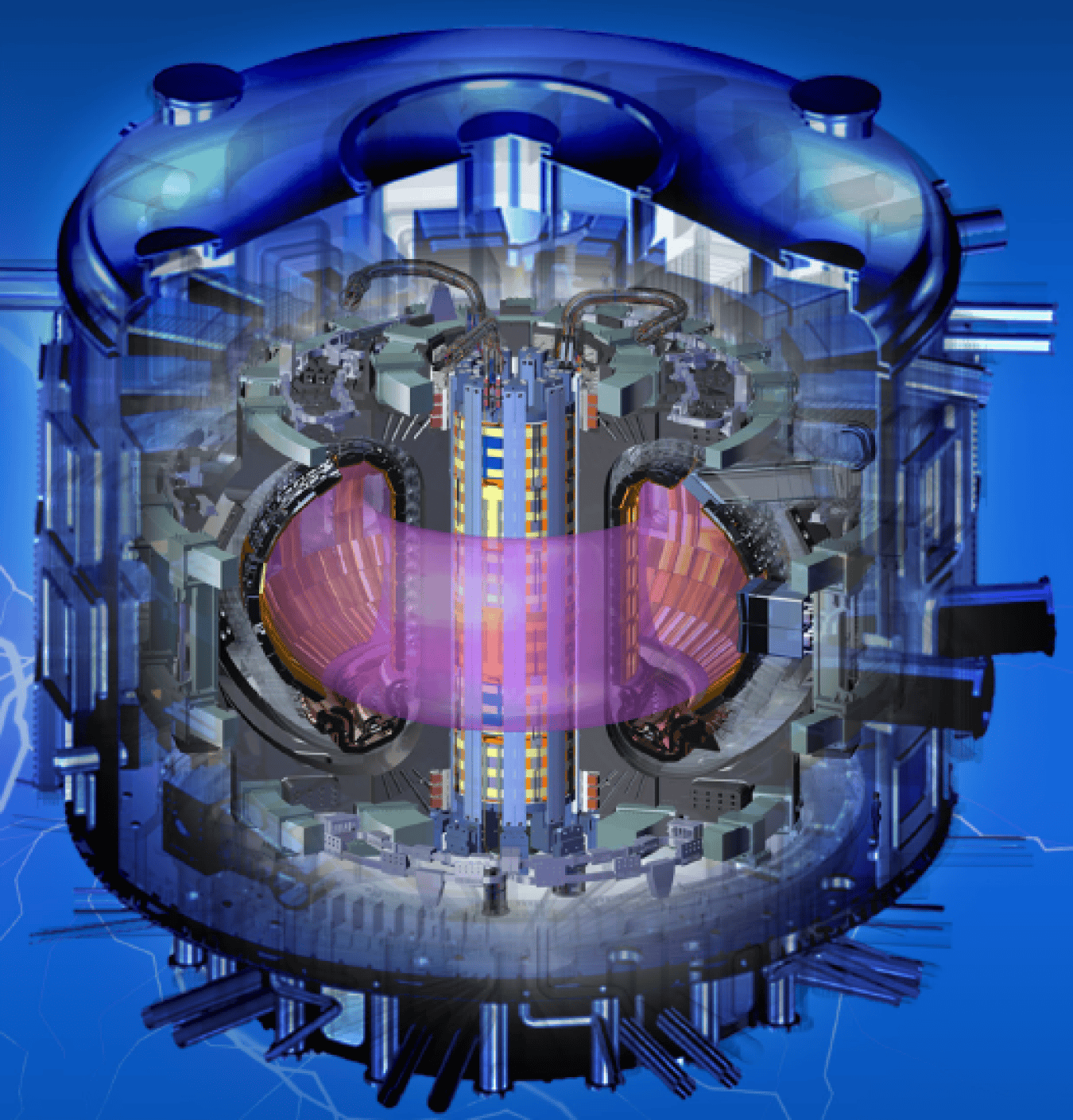
Researchers working on China’s ‘artificial sun’ have reported breaking a long-accepted threshold that has limited the operation of nuclear-fusion reactors for decades.
China’s Experimental Advanced Superconducting Tokamak (EAST) is a nuclear-fusion research reactor in Hefei. Researchers hope that it will one day produce clean, nearly limitless energy by replicating the fusion processes that power the Sun.
In fusion reactors, light-weight atoms are compressed under extreme pressure and heat to form heavier atoms. This process releases energy, but it must be optimized carefully so that the reactor produces more energy than it consumes.
One of the most promising reactor designs, the tokamak, confines plasma inside a doughnut-shaped chamber using magnetic fields. The plasma is then heated. To sustain fusion reactions, the plasma must reach an extremely high density — meaning many particles must be packed into a small volume.
But researchers thought that plasma could not exceed a certain density without becoming unstable. This upper limit — known as the Greenwald limit — has been a major obstacle for fusion research, particularly for tokamak-type devices.
In a paper published on 1 January in Science Advances, scientists working on China’s EAST device reported pushing plasma densities beyond this limit, achieving densities 30% to 65% higher than those normally reached by EAST.
“These results are very promising and should be explored in other tokamak devices,” says Jeronimo Olaya, a fusion plasma physicist at the French Alternative Energies and Atomic Energy Commission in Saint-Paul-lez-Durance.
Fewer impurities
In 2021, study co-author Dominique Escande, a plasma physicist at the Aix-Marseille University in France, and colleagues first proposed2 that the Greenwald limit could be surpassed by adjusting the conditions so that the plasma and the inner wall of the reactor are in a stable, mutually reinforcing state.
The EAST team used high power microwaves to raise the temperature of the initial fuel used to generate the plasma in a more efficient way than those used in conventional methods. This reduced the number of metal atoms that were knocked off the tokamak’s inner walls and mixed into the plasma. Fewer impurities mean less unwanted radiation, helping the plasma to remain stable even as its density increases.
The researchers also injected a high amount of neutral gas into the chamber. This provided more fuel for the plasma to reach high densities later in the experiment, while simultaneously cooling the region near the walls and further reducing the production of impurities.
To generate energy from fusion reactions in hot plasmas efficiently, three conditions are essential: high density, high temperature and long energy confinement time, says Olaya. But, so far, confined plasmas have not achieved these three conditions simultaneously, because sustaining a high temperature and density makes the plasma unstable. The next step is for researchers to combine high-density operations with advanced stability-control techniques to achieve conditions for a self-sustaining, burning plasma.
David Hammer, a nuclear engineer at Cornell University in Ithaca, New York, says that the researchers have demonstrated that the power of tokamaks can be increased without spending billions of dollars developing more powerful magnets to confine the plasma and raise its density. That will be important for making an economically viable tokamak fusion reactor, he says.
The findings could be applied to the International Thermonuclear Experimental Reactor (ITER) — a global effort to build the largest such fusion reactor — to make it more powerful. Although initially planned to begin experiments in 2020, the project has faced big setbacks owing to the COVID-19 pandemic, manufacturing issues and concerns over safety.
Study co-author Ping Zhu, a nuclear-fusion researcher at Huazhong University of Science and Technology in Wuhan, China, says that the team will make a proposal to repeat its experiment at ITER in southern France.