
The Challenge of Interplanetary Travel
Mars is not a fixed destination. Because both Earth and Mars orbit the Sun at different speeds and distances, the geometry between the two planets changes constantly. At their closest approach — a moment called opposition — Mars can be as near as 54.6 million kilometers from Earth. At their farthest, the two planets are separated by more than 400 million kilometers. Any practical mission architecture must therefore be designed around the orbital mechanics of the solar system, not simply the physical distance between the two worlds.

The most fuel-efficient path to Mars is known as a Hohmann transfer orbit, a half-ellipse that connects the orbit of Earth to the orbit of Mars. A spacecraft following this trajectory departs Earth during a specific window — called a launch window — that opens roughly every 26 months, when the geometry of the two planets is favorable. The transit time along a standard Hohmann transfer is approximately seven to nine months. Because the spacecraft is coasting through space on a ballistic arc for most of this time, very little propellant is consumed after the initial departure burn, making this approach highly mass-efficient.
The catch is time. A crew spending seven to nine months in transit would be exposed to significant doses of galactic cosmic radiation and solar energetic particles, experience substantial bone density loss and muscle atrophy in microgravity, and face profound psychological stress from isolation and confinement. The total mission duration — accounting for the transit, a surface stay of perhaps 500 days until the next favorable return window, and the journey home — could easily exceed two and a half years.
Propulsion Options for the 2030s and 2040s
The propulsion systems most likely to carry humans to Mars in this era fall into two broad categories: advanced chemical propulsion and solar electric or nuclear propulsion.
High-performance chemical propulsion, using liquid oxygen and liquid methane (LOX/LCH₄), is the closest to near-term readiness. Methane is attractive not only for its high specific impulse — a measure of propellant efficiency, expressed in seconds — of around 380 seconds, but because methane can theoretically be manufactured on Mars using the Sabatier reaction, which combines carbon dioxide from the Martian atmosphere with hydrogen to produce methane and water. This process, known as in-situ resource utilization (ISRU), is central to the philosophy behind SpaceX's Starship vehicle, which was designed from the outset with a Mars methane-production architecture in mind. Under this concept, a fully fueled return vehicle would be waiting on the surface before the crew departs Earth, having been filled by robotic propellant-production equipment sent on a prior mission.
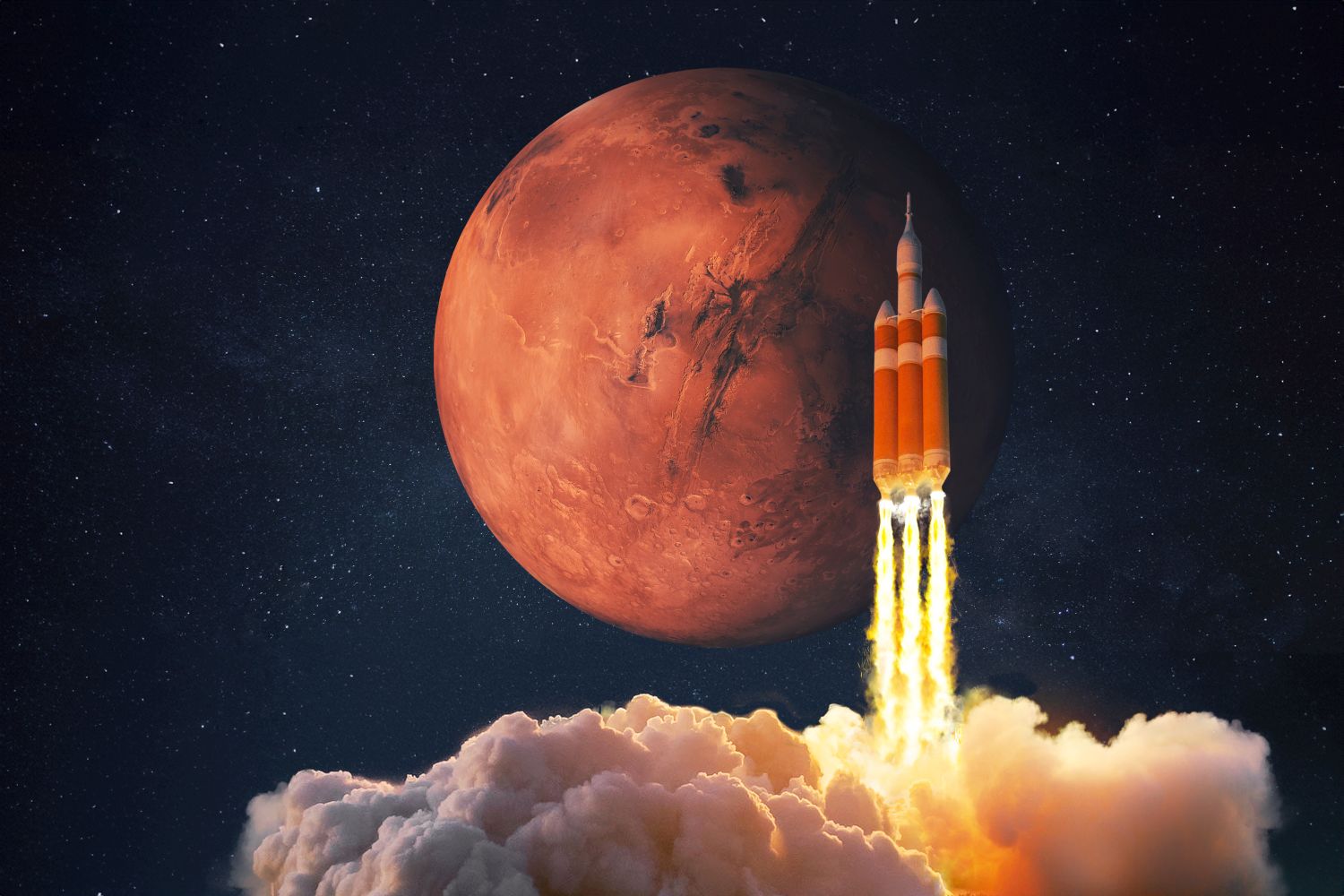
Nuclear thermal propulsion (NTP) is a technology that was successfully demonstrated in the United States under the NERVA program in the 1960s and early 1970s, but never flown in space. In an NTP system, a nuclear reactor heats a propellant — typically liquid hydrogen — to extremely high temperatures, expelling it through a nozzle to produce thrust. The specific impulse of an NTP engine is roughly twice that of the best chemical engines, meaning it can achieve the same change in velocity using half the propellant mass. This improved efficiency translates to either a shorter transit time, a larger payload, or both. NASA and the Defense Advanced Research Projects Agency (DARPA) have collaborated in recent years on the DRACO program, which aims to demonstrate a nuclear thermal rocket in Earth orbit. If this technology matures on schedule, it could be available for crewed Mars missions in the late 2030s or 2040s.
Solar electric propulsion (SEP) uses large photovoltaic arrays to generate electricity, which then ionizes and accelerates a propellant — typically xenon — to produce low but highly efficient thrust. Ion drives have specific impulses in the thousands of seconds and have been used successfully on robotic spacecraft. Their limitation for crewed missions is low thrust: an ion engine accelerates very gradually, and a piloted vehicle cannot spend months spiraling outward through Earth's radiation belts or take a long, slow trajectory to Mars. SEP is therefore more likely to be used for uncrewed cargo missions — pre-positioning supplies, equipment, and propellant on Mars before a crew departs — rather than for the crewed transit itself.
Mission Architecture: A Staged Approach
The most widely studied approach to human Mars exploration involves separating the mission into several distinct phases, often called a pre-deployment or split mission architecture.
In the first phase, several years before any crew departs, robotic precursor missions are sent to Mars. These include a propellant production plant, a power system to run it, pressurized surface habitats, and a pre-fueled ascent vehicle — the rocket that will eventually lift the crew off the Martian surface for their return journey. Robotic systems verify that propellant production is working and that the habitat is pressurized and ready before any humans leave Earth. This dramatically reduces the mass that must be launched from Earth, because the return vehicle's propellant is made on Mars rather than carried from home.
In the second phase, a crew of four to six astronauts departs Earth aboard a dedicated transit habitat. This vehicle would include radiation shielding (possibly in the form of water walls or polyethylene panels around crew sleeping quarters), a medical bay, exercise equipment to mitigate the effects of microgravity, and enough food and consumables for the entire mission. The crew may enter a Mars orbit before descending, or execute a direct entry into the Martian atmosphere, depending on the architecture chosen.
On the surface, the crew would live and work in pre-deployed habitats for roughly 500 days — long enough to conduct meaningful experiments, test resource extraction techniques, and justify the enormous cost of getting there. Mars has a thin atmosphere of mostly carbon dioxide, surface temperatures ranging from about −125°C at the poles in winter to 20°C on a warm summer afternoon at the equator, and no global magnetic field to deflect solar radiation. The challenges of surviving and working in this environment are formidable, but not categorically different from those faced by early Antarctic expeditions — a comparison mission planners frequently invoke.
The Role of the Moon as a Proving Ground
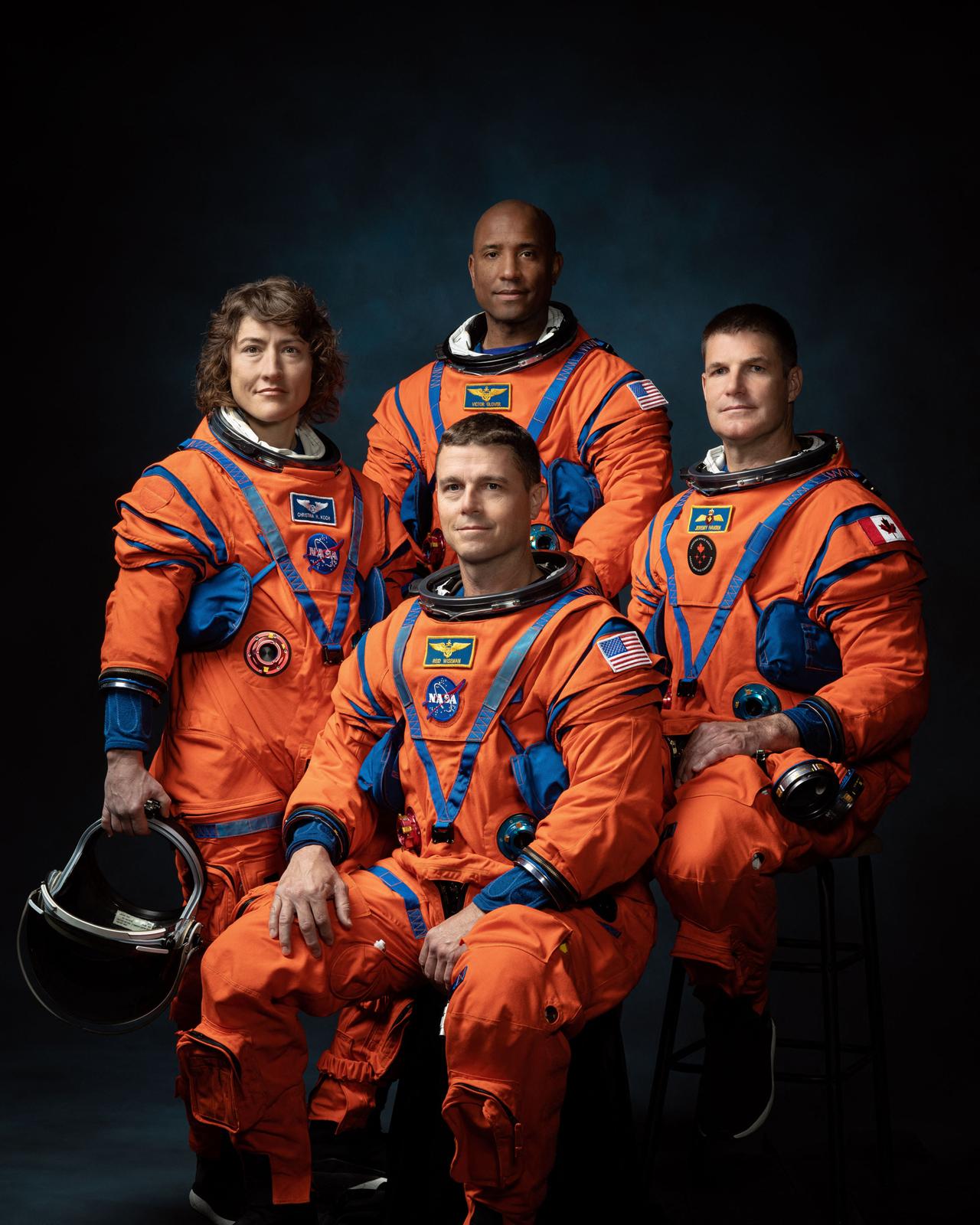
Before any crew departs for Mars, the Moon will almost certainly serve as a testing and shakedown environment. Lunar missions allow engineers to evaluate life support systems, ISRU techniques, surface habitats, and EVA suits in a real space environment, while remaining close enough to Earth that a rescue or resupply is at least theoretically possible. The Artemis program and its international partners envision a Lunar Gateway — a small space station in lunar orbit — that could serve as a staging node for deep space missions and a platform on which Mars-transit systems can be validated. Technologies that fail on the Moon can be fixed; technologies that fail beyond the Moon cannot.
Looking Ahead
A crewed Mars mission in the 2030s or 2040s is ambitious but not physically impossible. The orbital mechanics are well understood, the propulsion options are maturing, and the general outlines of a workable architecture have been studied for decades. What has historically been lacking is not ingenuity, but sustained political will and funding. Whether the mission comes from a national space agency, an international consortium, or a private entity, the pathway to Mars will require a level of institutional commitment comparable to the Apollo program — spread over a longer timescale and applied to a far more distant and unforgiving world.